

OpenAI officially introduced GPT-6 Astra on September 3, 2026, positioning it as its most capable model for difficult end-to-end work involving reasoning, coding, research, computer use and professional workflows. It arrived a little over four months after GPT-5.5 was introduced on April 23, 2026, but Astra is not simply GPT-5.5 with a new name and slightly better benchmark scores.
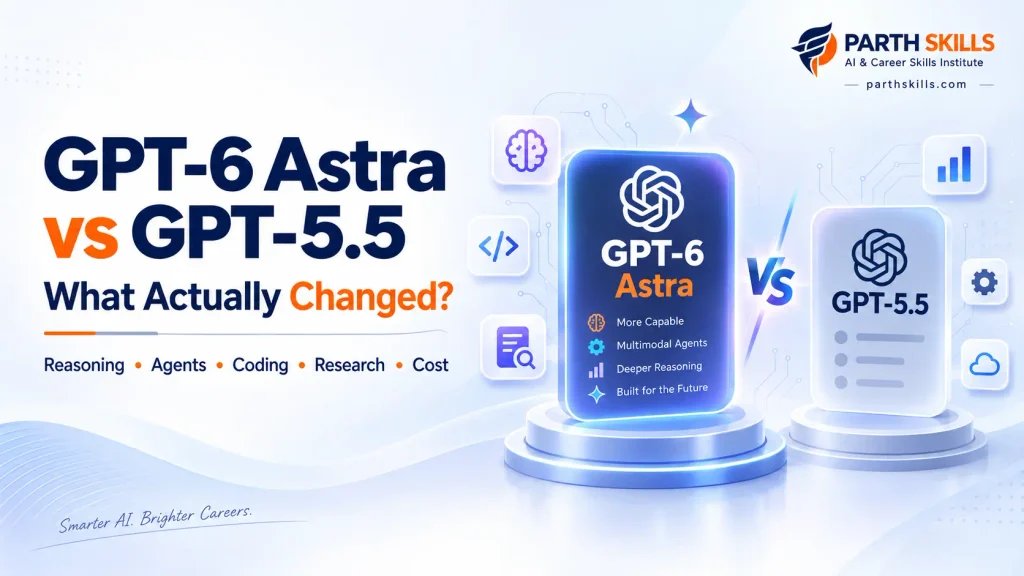
One of the most important facts is that the biggest GPT-6 Astra upgrade is not a larger context window. GPT-6 Astra and GPT-5.5 both support a 1.05-million-token context window and up to 128,000 output tokens. The more meaningful changes involve how Astra reasons, operates computers, coordinates tools, follows complex instructions, manages long-running workflows and adapts while work is already in progress.
In this detailed GPT-6 Astra vs GPT-5.5 comparison, we examine the differences in reasoning, coding, AI agents, computer use, research, API pricing, context windows, knowledge cutoffs, tool calling, benchmarks and real-world use cases so you can understand what actually changed and whether upgrading makes sense.
GPT-6 Astra vs GPT-5.5: Quick Answer
GPT-6 Astra is the stronger model for complex agentic work, advanced coding, research, computer use and long-running professional workflows, while GPT-5.5 remains a compelling option when API cost and efficiency matter more than obtaining OpenAI’s highest available capability.
Astra does not increase the headline context-window size over GPT-5.5. Instead, OpenAI has concentrated on improving reasoning quality, computer interaction, instruction adherence, tool coordination, task completion, agent behavior and built-in knowledge. For users who mainly need ordinary writing, summarization or predictable API tasks, those improvements may not always justify Astra’s higher price. For complex multi-step workflows, however, the differences can be much more significant.
GPT-6 Astra vs GPT-5.5 Comparison
| Feature | GPT-5.5 | GPT-6 Astra |
|---|---|---|
| Release date | April 23, 2026 | September 3, 2026 |
| OpenAI positioning | Flagship for complex professional work | Most capable model for hardest end-to-end work |
| Context window | 1,050,000 tokens | 1,050,000 tokens |
| Maximum output | 128,000 tokens | 128,000 tokens |
| Knowledge cutoff | December 1, 2025 | April 30, 2026 |
| API input price | $5 / 1M tokens | $10 / 1M tokens |
| Cached input | $0.50 / 1M tokens | $1 / 1M tokens |
| API output price | $30 / 1M tokens | $50 / 1M tokens |
| Reasoning levels | none, low, medium, high, xhigh | low, medium, high, xhigh, max |
| Image input | Yes | Yes |
| Direct audio input/output | No | No |
| Direct video input/output | No | No |
| Computer use | Supported | Supported, substantially improved |
| Web search | Supported | Supported |
| File search | Supported | Supported |
| Code interpreter | Supported | Supported |
| Hosted shell | Supported | Supported |
| MCP | Supported | Supported |
| Skills | Supported | Supported |
| Fine-tuning | Not supported | Not supported |
| Async tool calling | Not an Astra-era feature | New Astra capability |
| Mid-turn steering | No equivalent Astra implementation | Supported |
| Dynamic reasoning changes | Limited | Supported during conversation |
| Safety monitoring | Existing safeguards | New misalignment monitoring layer |
The comparison immediately reveals something important: GPT-6 Astra is not simply GPT-5.5 with larger technical limits. Both models retain the same headline context and output capacity, while Astra introduces a newer knowledge cutoff, higher API pricing and substantially stronger capabilities around agentic execution, computer use and advanced reasoning.
What Is GPT-6 Astra?
GPT-6 Astra is OpenAI’s first GPT-6-branded frontier model and is designed primarily around end-to-end task completion. Rather than evaluating an AI model only by how well it answers an isolated question, Astra increasingly focuses on whether the model can understand a complicated objective, examine relevant context, use multiple tools and applications, adapt when circumstances change, verify its own work and ultimately deliver a finished result.
OpenAI highlights capabilities including complex reasoning, software engineering, computer use, web research, professional documents, spreadsheets, presentations, scientific workflows, browser-based work and multi-step automation. These are also increasingly important skills in practical AI courses and applied AI training, where learning how models interact with real tools is becoming as important as learning how to write prompts.
Astra can therefore be viewed less as a conventional chatbot upgrade and more as another step toward AI systems that can work across software, websites, files, applications and tools while maintaining the context of a larger assignment.
What Is GPT-5.5?
GPT-5.5 launched on April 23, 2026 as a major step toward AI models capable of handling real-world professional work. It improved substantially on previous GPT generations in agentic coding, computer use, online research, spreadsheet work, document generation, data analysis, scientific reasoning, tool usage and long-running tasks.
That context is important because GPT-6 Astra is not replacing a basic chatbot. GPT-5.5 was already designed to handle relatively messy, multi-part instructions with less step-by-step supervision than earlier generations. Astra builds on that agentic direction and pushes it further toward sustained, end-to-end execution.
15 Key Differences Between GPT-6 Astra and GPT-5.5
1. GPT-6 Astra Is More About AI Agents Than a Bigger Context Window
One of the most surprising differences between GPT-6 Astra and GPT-5.5 is something that did not change. Both models support a 1,050,000-token context window and a maximum output of 128,000 tokens. Anyone expecting GPT-6 to immediately jump to a two-million, five-million or ten-million-token context window will therefore not find that in OpenAI’s published specifications.
Instead, the more important question is how reliably a model uses the enormous amount of information already available to it. Context-window size alone does not tell us whether a model can locate a requirement buried hundreds of thousands of tokens earlier, distinguish current instructions from outdated ones, remember project decisions, track failed attempts or use retrieved information correctly. For businesses and developers, effective context utilization can be more valuable than simply increasing maximum context size.
2. GPT-6 Astra Adds a New Max Reasoning Level
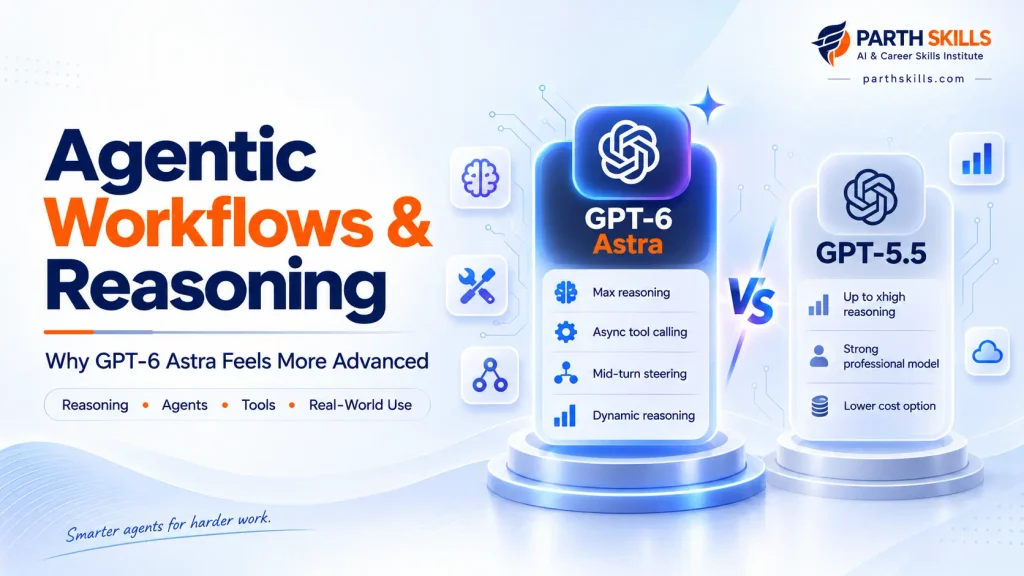
GPT-5.5 supports reasoning levels ranging from none → low → medium → high → xhigh, while GPT-6 Astra supports low → medium → high → xhigh → max. The none option disappears at this level of the model family and a new max reasoning setting becomes available.
This provides a useful clue about Astra’s positioning. It is primarily targeted at work where better reasoning and more reliable task completion can justify additional compute, including difficult software debugging, strategic analysis, large research assignments, multi-document analysis, mathematical reasoning, scientific workflows and complex automation. For high-volume lightweight classification or simple text generation, maximum frontier reasoning would often be unnecessary.
3. GPT-6 Astra Has a Newer Knowledge Cutoff
GPT-5.5’s API documentation lists a knowledge cutoff of December 1, 2025, while GPT-6 Astra lists April 30, 2026. That represents roughly five additional months of built-in knowledge and can reduce the gap between what the model already knows and the environment in which it is operating.
A newer knowledge cutoff does not replace web search. Breaking news, current product prices, recent regulations, live events and fast-changing software information may still require external research. The distinction is that Astra begins with a more recent built-in understanding before those external tools are used.
4. Computer Use Is One of GPT-6 Astra’s Biggest Upgrades
GPT-5.5 already supported computer-use capabilities, but Astra pushes significantly further toward a model that can operate a computer as part of completing a larger job. OpenAI’s examples include navigating websites, filling forms, updating CRM records, organizing calendars, conducting research, working inside document editors, analysing scientific data, generating plots, building websites, performing frontend QA, installing software and troubleshooting applications.
OpenAI reported GPT-6 Astra scoring 72.6% on OSWorld 2.0 and 92.7% on ScreenSpot-Pro in the configurations disclosed for its launch. Individual benchmark scores should not be treated as perfect predictions of real-world performance, but they demonstrate an important direction: computer operation itself is becoming a core frontier-model capability rather than an experimental add-on.
5. Asynchronous Tool Calling Changes AI Agent Architecture
GPT-6 Astra introduces an important developer capability: asynchronous tool calling. Traditional AI-agent workflows may call an external tool and wait for the result before continuing. Astra can perform other independent reasoning or useful work while an asynchronous function or custom tool is still running.
For example, a research agent could search public sources, request information from a company database, continue analysing evidence it already has, and then incorporate the database response when it arrives. A marketing agent could request analytics data while simultaneously reviewing campaign creatives, then combine both outputs into final recommendations.
This matters for developers building practical AI automation workflows because sophisticated agents often depend on several APIs, tools and databases with different response times. Reducing unnecessary waiting can make complex systems more responsive and efficient.
6. GPT-6 Astra Can Be Steered While It Is Working
Another important upgrade is mid-turn steering. Imagine asking an AI agent to research the 20 biggest digital marketing agencies in India and create a competitive report. Partway through the process, you realize that you only care about agencies serving SaaS companies. In traditional workflows, you might have to stop the task, revise the prompt and restart much of the work.
Astra can accept updated instructions while work is already in progress, allowing the workflow to change direction while preserving completed work where the API architecture supports it. The interaction therefore moves beyond a simple Prompt → Answer pattern toward Goal → Work → Human Direction → Adjustment → Continued Work → Result. That is much closer to how people collaborate on long-running assignments.
7. Reasoning Effort Can Change During a Workflow
GPT-6 Astra also allows developers to change reasoning effort as a workflow progresses. A system might use low reasoning while collecting routine research, switch to high reasoning for complex financial analysis, use maximum reasoning for final validation and return to low reasoning for straightforward formatting.
This gives developers greater control over where expensive reasoning is actually used. Instead of treating an entire long-running task as equally difficult, applications can allocate more compute to the stages where deeper analysis provides meaningful value.
8. Coding Has Become More End-to-End
GPT-5.5 was already a powerful coding model. At launch, OpenAI reported 82.7% on Terminal-Bench 2.0 and 58.6% on SWE-Bench Pro. Astra’s launch uses newer benchmark generations in several places, including Terminal-Bench 4.0, so those headline numbers should not be treated as direct apples-to-apples comparisons.
The more meaningful development is the shift from isolated coding assistance toward complete software-engineering workflows. Astra is positioned around understanding codebases, implementing changes, debugging, testing, browser verification, application migrations, frontend judgment and long-running development. In practical terms, the evolution is from “write this function” toward “understand this repository, fix the issue, test the application, verify the result and deliver working output.”
That same shift is relevant to areas such as AI-assisted website development, where generating code is only one part of the overall development process.
9. Browsing and Research Are Better
Both GPT-5.5 and GPT-6 Astra can work with web-search tools, but stronger reasoning, context handling and tool coordination can make the difference between simply locating webpages and conducting a coherent research workflow across multiple sources.
One overlapping benchmark reported by OpenAI is BrowseComp, where GPT-5.5 was reported at 84.4% and GPT-6 Astra at 91.5%. Benchmark environments can change, so this should not be interpreted as an exact percentage improvement that will appear in every research task. However, OpenAI’s overall positioning clearly places Astra above earlier GPT models for complex browsing and research workflows.
10. Abstract Reasoning Has Improved
Some of GPT-6 Astra’s strongest headline results involve ARC-AGI evaluations. OpenAI reported the following results for GPT-5.5 and GPT-6 Astra:
| Benchmark | GPT-5.5 | GPT-6 Astra |
|---|---|---|
| ARC-AGI-1 | 95.0% | 98.5% |
| ARC-AGI-2 | 85.0% | 95.0% |
GPT-6 Astra also produced a headline 99.9% ARC-AGI-3 result in OpenAI’s launch evaluation. These scores are notable, but benchmark performance depends on reasoning effort, tools, evaluation harnesses and scoring methodology. A higher benchmark score should therefore be treated as evidence of stronger capability rather than a guarantee that Astra will be a fixed percentage better than GPT-5.5 in every real-world task.
11. Professional Work Is Becoming a Core AI Benchmark
GPT-6 Astra is not positioned only for developers. OpenAI also highlights professional work involving presentations, documents, spreadsheets, data analysis, legal workflows, CAD, business research, design and scientific analysis. The model is designed to follow instructions and templates while retaining relevant context rather than indiscriminately pushing every piece of available information into an output.
This represents an important change in how useful AI systems are evaluated. Instead of asking only “How good was the model’s answer?”, businesses increasingly need to ask “How much finished, usable work did the model actually complete?” That distinction is particularly important in workflows involving data analytics, research, documents and automated business processes.
12. GPT-6 Astra Is More Expensive Than GPT-5.5
The capability increase comes with substantially higher API pricing. Developers therefore need to evaluate not only which model produces the best answer, but which model provides the best cost per successfully completed task.
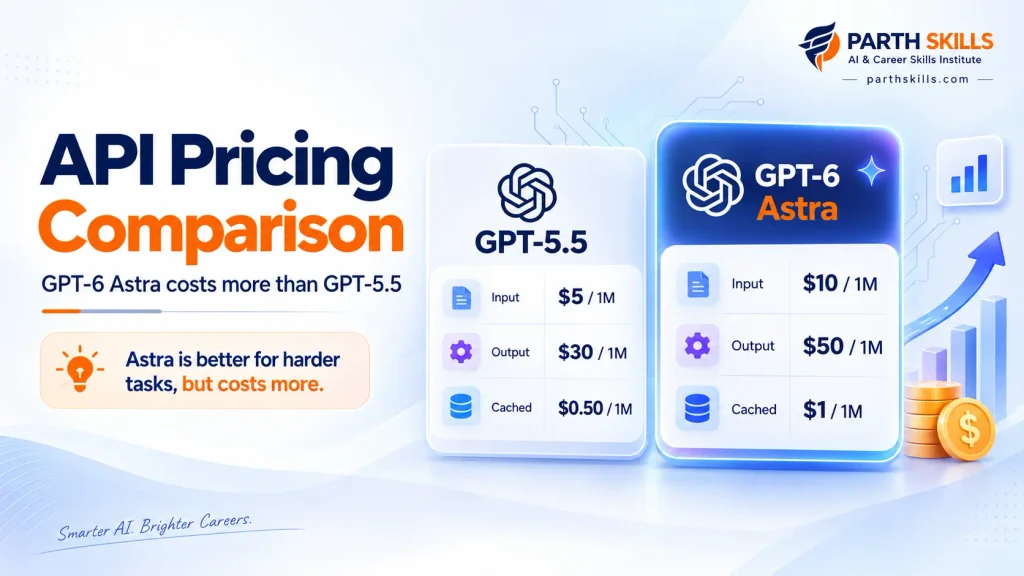
GPT-5.5 API Pricing
- Input: $5 per million tokens
- Cached input: $0.50 per million tokens
- Output: $30 per million tokens
GPT-6 Astra API Pricing
- Input: $10 per million tokens
- Cached input: $1 per million tokens
- Output: $50 per million tokens
At those rates, Astra costs 2× more for standard input tokens, 2× more for cached input and approximately 1.67× more for output tokens.
For example, a request containing 100,000 input tokens and producing 20,000 output tokens would have an approximate base token cost of $1.10 with GPT-5.5 versus $2.00 with GPT-6 Astra. This simplified example excludes separate tool charges, special processing tiers and other applicable costs.
OpenAI argues that a stronger model may sometimes solve difficult tasks with fewer attempts or fewer output tokens, potentially reducing cost per successful outcome. That is different from saying Astra is cheaper per token—it clearly is not.
13. Very Long Prompts Can Cost Even More
Both model families also have special pricing considerations for very large prompts. OpenAI states that prompts above 272,000 input tokens can receive elevated token pricing, so developers building million-token applications should not calculate costs using only the headline base rates.
A large context window should therefore be treated as a capability rather than an invitation to send every available document into every request. Retrieval, caching, context filtering and efficient prompt design remain important. Developers who want to improve those skills can also explore structured prompt engineering rather than relying only on increasingly large context windows.
14. GPT-6 Astra Adds Stronger Safety Monitoring
Astra also represents a significant change in cybersecurity capability. OpenAI classifies the model at the Critical cybersecurity capability threshold under its Preparedness Framework and has introduced additional safeguards around advanced cyber activity.
OpenAI reported Astra reaching 100% on ExploitBench and showing significantly stronger results on several cybersecurity evaluations than GPT-5.6 Sol. Because of those capabilities, Astra includes additional monitoring intended to detect situations in which an agent might be acting beyond the user’s intended authorization. In some cases, legitimate work may therefore be paused or stopped for review. Greater capability does not necessarily mean fewer safety controls.
15. Migrating From GPT-5.5 to GPT-6 Astra Is Not Completely Drop-In
Developers moving from GPT-5.5 to Astra should review their implementation rather than simply replacing the model name. The GPT-6 Astra API model identifier is gpt-6-astra, but several configuration and tool-calling differences need to be considered.
reasoning.effort: noneis not supported.maxreasoning is available.- Custom
temperatureis not supported. - Custom
top_pis not supported. - Log-probability parameters are restricted.
- Tool-calling workflows should use the Responses API.
- Caching behavior should be reviewed during migration.
- Asynchronous tool capabilities are available.
- Mid-turn steering is available.
These differences matter particularly when Astra is being used inside advanced agent systems, custom applications or automation platforms rather than as a simple text-generation endpoint.
What Has Not Changed Between GPT-6 Astra and GPT-5.5?
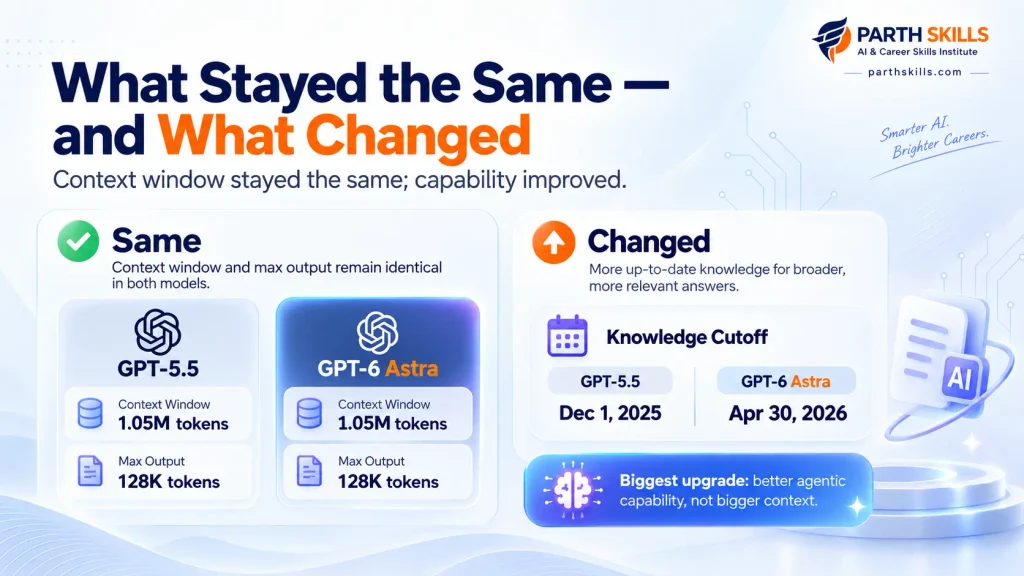
The GPT-6 name may suggest that every technical limit has increased dramatically, but several important specifications remain unchanged between the two models.
Context Window
Both GPT-5.5 and GPT-6 Astra support a 1.05-million-token context window.
Maximum Output
Both models support up to 128,000 output tokens.
Image Input
Both models can accept images as input alongside text.
Audio and Video
The base model specification pages do not list direct audio or video input/output support for either model. Those media workflows may instead rely on other models or tools in the broader platform.
Fine-Tuning
Fine-tuning is currently listed as not supported for both GPT-5.5 and GPT-6 Astra.
Core Tool Ecosystem
Both models can operate within a broader ecosystem that includes capabilities such as web search, file search, code execution, hosted shell, computer use and MCP integrations. The GPT-6 shift is therefore less about introducing every tool for the first time and more about how effectively the model can coordinate those capabilities as part of a complete workflow.
Is GPT-6 Astra Better Than GPT-5.5?
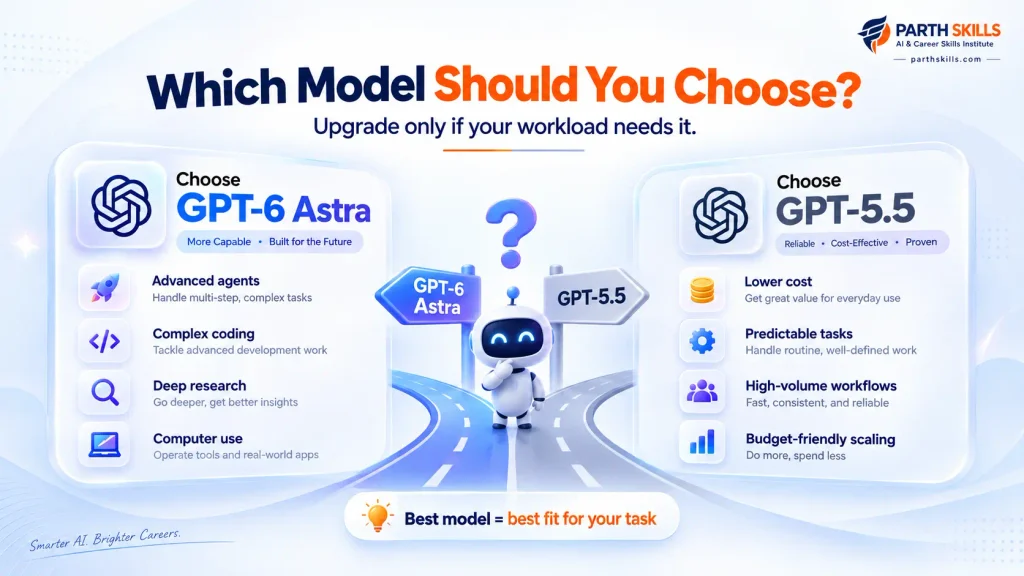
Yes, GPT-6 Astra is generally the stronger model for the most demanding tasks. It is particularly well suited to complex reasoning, long-running autonomous workflows, difficult software engineering, computer use, browser automation, multi-tool agents, advanced research, scientific workflows, professional artifact creation and projects that require repeated verification.
However, “better” does not automatically mean better value for every application. GPT-5.5 costs significantly less through the API, and there is little benefit in paying frontier-model prices for predictable workloads that GPT-5.5 already completes reliably. The correct choice depends on task difficulty, required accuracy, latency, volume and the cost of failure.
GPT-6 Astra vs GPT-5.5 by Use Case
GPT-6 Astra vs GPT-5.5 for Coding
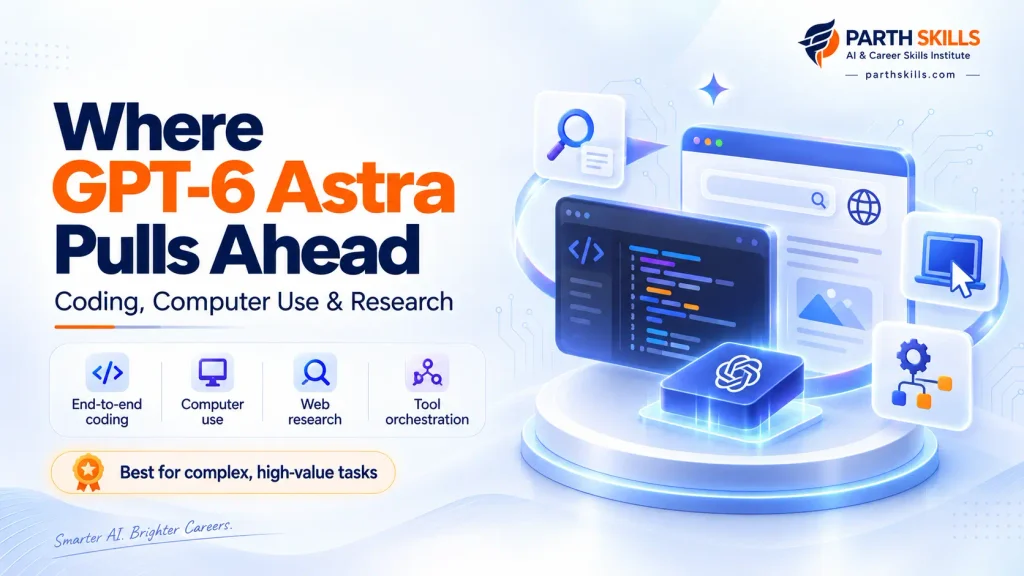
Winner for complex engineering: GPT-6 Astra. Astra is the stronger choice for full-repository analysis, difficult debugging, large refactors, browser testing, migration projects, frontend QA, architecture reasoning and long-running coding agents. GPT-5.5 can still be more economical for smaller coding requests or applications processing large volumes of predictable development tasks.
GPT-6 Astra vs GPT-5.5 for Research
Winner: GPT-6 Astra. Its combination of stronger reasoning, browsing, context handling and tool orchestration makes it more attractive for competitive research, academic research, company analysis, market studies, multi-source investigations and evidence-heavy reports. Important claims should still be checked against primary sources because no AI model eliminates the need for verification.
GPT-6 Astra vs GPT-5.5 for Digital Marketing
For routine marketing tasks such as social-media captions, basic ad-copy variations, blog outlines, keyword categorization and simple email drafting, using Astra may be unnecessary. For connected workflows involving market research → competitor analysis → audience research → keyword intelligence → content strategy → landing-page recommendations → analytics review, the stronger agentic model becomes much more useful.
The important difference is not simply whether Astra can write better marketing copy. It is whether the model can coordinate multiple stages of a campaign and maintain context across them. This is increasingly relevant to modern AI-enabled digital marketing, where marketers are learning to combine human strategy with AI-assisted research, content, analytics and automation.
GPT-6 Astra vs GPT-5.5 for AI Agents
Winner: GPT-6 Astra. AI agents are arguably the clearest upgrade category because Astra combines computer use, tool calling, asynchronous execution, mid-turn steering, dynamic reasoning and stronger support for persistent multi-step workflows.
Developers can pair frontier reasoning models with workflow systems rather than expecting the model itself to replace every automation layer. For example, tools covered in an n8n automation course can handle triggers, APIs, databases and deterministic workflow steps while an advanced GPT model handles reasoning-intensive portions of the process.
Should You Upgrade From GPT-5.5 to GPT-6 Astra?
Choose GPT-6 Astra When
- Your task is expensive to get wrong.
- You need an AI model to carry a project through multiple stages.
- The model must interact with software, websites or several tools.
- You need advanced research or complex software engineering.
- Human time saved matters more than minimizing token price.
- Your workflow regularly benefits from high or maximum reasoning.
Stay With GPT-5.5 When
- Your current evaluations already show sufficient accuracy.
- You operate at high API volume and cost is important.
- Your workloads are relatively predictable.
- Latency and efficiency matter more than frontier reasoning.
- You mainly need straightforward text generation or structured analysis.
Best Model-Routing Strategy for Developers
For many production applications, the best architecture will not be “GPT-6 Astra for everything.” A better strategy may route routine tasks to lower-cost models, use GPT-5.5 for demanding but predictable professional work, and reserve GPT-6 Astra for genuinely complex or high-value tasks where stronger reasoning can materially improve the probability of successful completion.
Model routing can often deliver a better cost-to-quality ratio than standardizing every request on the most expensive model available.
Did GPT-6 Astra Directly Replace GPT-5.5?
Not exactly. OpenAI released GPT-5.6 on July 9, 2026, between GPT-5.5 and GPT-6 Astra. This matters because many of the benchmark comparisons included in OpenAI’s GPT-6 Astra launch materials use GPT-5.6 Sol as the previous-generation reference rather than GPT-5.5.
For that reason, benchmark results from different model announcements should not automatically be presented as direct head-to-head GPT-6 Astra vs GPT-5.5 comparisons. This article separates compatible published specifications from results that use different benchmark versions or evaluation setups.
GPT-6 Astra Availability
OpenAI announced GPT-6 Astra on September 3, 2026. Official rollout information describes availability expanding across ChatGPT and developer platforms, including eligible ChatGPT plans, the OpenAI API and major cloud-platform integrations.
- ChatGPT Plus
- ChatGPT Pro
- ChatGPT Business
- ChatGPT Enterprise
- OpenAI API
- Microsoft Azure
- AWS Bedrock
Because model rollouts can be staged, users on the same broad subscription category may not necessarily receive access at exactly the same time. The current model selector, OpenAI API account or official release documentation should therefore be checked for the latest account-specific availability.
GPT-6 Astra vs GPT-5.5: Final Verdict
GPT-6 Astra is not primarily a “bigger context window” upgrade because its headline context window remains the same as GPT-5.5. The more important GPT-6 transition is toward AI that can reason → research → operate tools → use software → adapt → verify → continue → finish.
GPT-5.5 demonstrated that frontier models could behave more like professional collaborators. GPT-6 Astra pushes that concept further toward autonomous, end-to-end digital work. For ordinary prompts, the practical improvement may sometimes feel smaller than the generational name implies. For difficult coding, research, computer use, automation and multi-step professional workflows, however, the difference can be much more meaningful.
For API developers, the trade-off is equally important: GPT-6 Astra offers more capability but costs materially more per token. The best production model is therefore not automatically the newest or most expensive one. It is the least expensive model that can reliably complete your specific task at the quality and success rate your application requires.
Frequently Asked Questions About GPT-6 Astra vs GPT-5.5
Is GPT-6 Astra better than GPT-5.5?
Yes. GPT-6 Astra is positioned as the stronger model for difficult end-to-end work, with major advantages in complex reasoning, computer use, software engineering, research and agentic workflows. GPT-5.5 can still offer better value for less demanding tasks because it has lower API pricing.
When was GPT-6 Astra released?
OpenAI announced GPT-6 Astra on September 3, 2026, with availability rolling out across supported ChatGPT plans, the API and other platforms.
How large is the GPT-6 Astra context window?
GPT-6 Astra supports a 1,050,000-token context window and up to 128,000 output tokens.
Is GPT-6 Astra’s context window bigger than GPT-5.5?
No. GPT-5.5 also supports a 1,050,000-token context window and up to 128,000 output tokens. The biggest Astra improvements are therefore related to reasoning, agents, computer use, tool coordination and task completion rather than a larger headline context limit.
What is GPT-6 Astra’s knowledge cutoff?
OpenAI’s API documentation lists April 30, 2026 as GPT-6 Astra’s knowledge cutoff, compared with December 1, 2025 for GPT-5.5.
How much does GPT-6 Astra cost?
The standard API rate listed for GPT-6 Astra is $10 per million input tokens and $50 per million output tokens, with separate rates for cached input and potentially other processing or tool usage.
How much does GPT-5.5 cost?
GPT-5.5’s standard API pricing is listed at $5 per million input tokens and $30 per million output tokens, making it considerably less expensive than GPT-6 Astra on a per-token basis.
Does GPT-6 Astra support computer use?
Yes. Computer use is one of GPT-6 Astra’s most important capabilities, allowing supported agent workflows to interact with websites, applications and graphical interfaces as part of larger tasks.
Can GPT-6 Astra browse the web?
Yes. GPT-6 Astra can work with web-search capabilities through OpenAI’s tool ecosystem, making it suitable for research tasks that require information beyond the model’s built-in knowledge cutoff.
Does GPT-6 Astra support image input?
Yes. GPT-6 Astra accepts images alongside text input. The base model documentation does not list direct audio or video input/output in the same way.
Can GPT-6 Astra be fine-tuned?
Not currently according to the model documentation. Fine-tuning is also listed as unsupported for GPT-5.5.
Should developers replace GPT-5.5 with GPT-6 Astra?
Not automatically. Developers should test both models against representative production workloads and compare successful-task rate, latency, token consumption and total cost. If GPT-5.5 already completes a particular workload reliably, moving every request to the more expensive Astra model may provide limited economic benefit.
Is GPT-6 Astra AGI?
There is no universally accepted technical threshold that makes a model definitively artificial general intelligence. GPT-6 Astra’s benchmark performance and real-world capabilities can be evaluated objectively, but broad AGI labels remain subject to differing definitions and interpretations.