
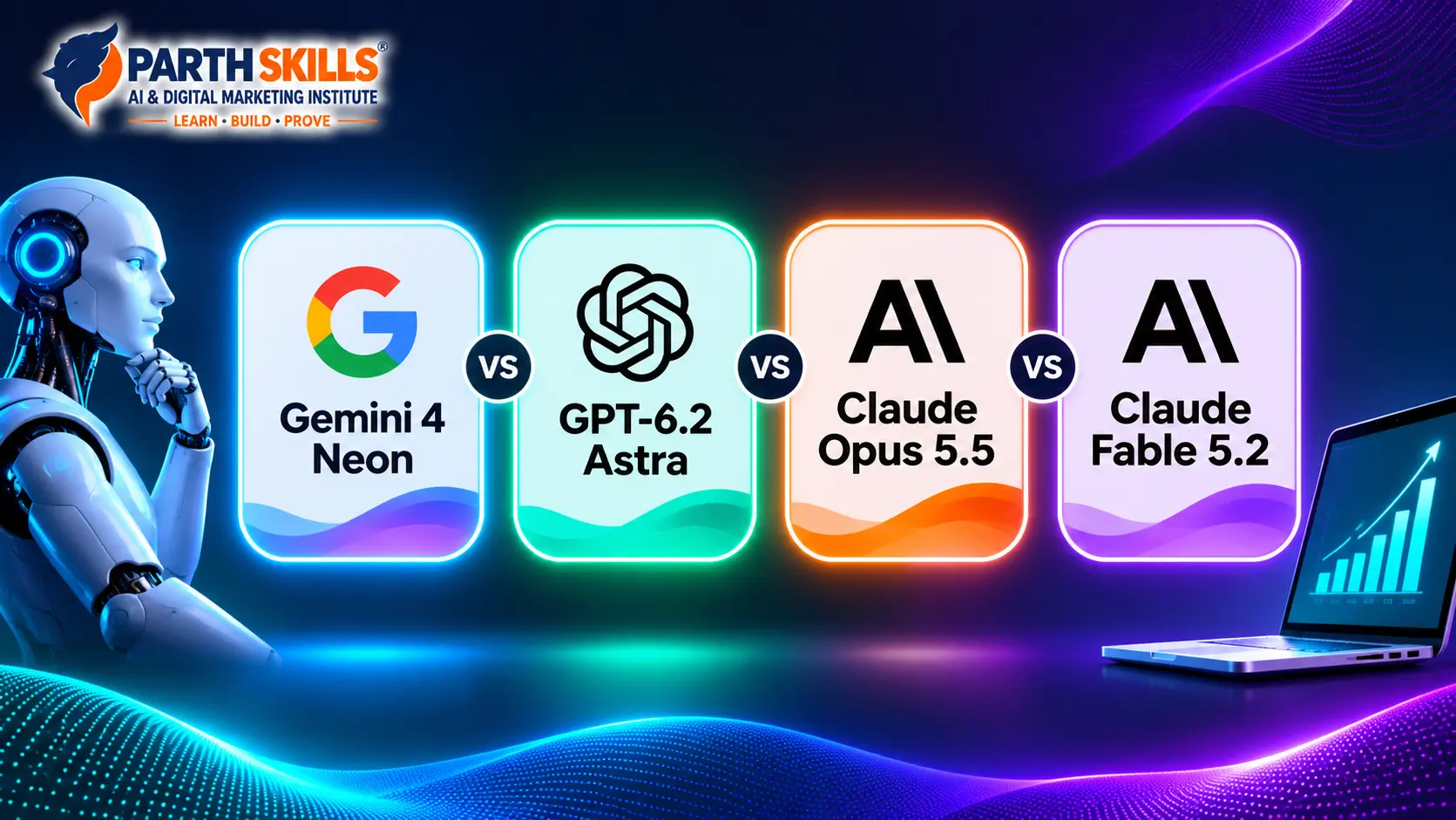
The competition between Google, OpenAI and Anthropic has intensified with the arrival of three major AI models in November 2026: Gemini 4 Neon, GPT-6.2 Astra and Claude Fable 5.2.
Google introduced Gemini 4 Neon on November 18, just one day after OpenAI released GPT-6.2 Astra and Sol on November 17. Anthropic had already launched Claude Fable 5.2 on November 9, extending its model family beyond the established Claude Opus 5.5.
These releases bring improvements in coding, advanced reasoning, AI agents, professional research, multimodal analysis and complex business workflows. However, they also make choosing the right model more complicated.
Should a developer use Gemini 4 Neon for its lower API pricing and multimodal capabilities? Is GPT-6.2 Astra better for professional reports and software development? Does Claude Fable 5.2 offer stronger reasoning? And is the more affordable Claude Opus 5.5 still a sensible option?
There is no universal winner. Independent benchmarks show different models leading different categories, while their API prices and product integrations vary substantially.
This detailed Gemini 4 Neon vs GPT-6.2 Astra vs Claude comparison examines technical specifications, independent benchmark scores, API pricing, reasoning capabilities, coding performance, automation, access and practical applications.
The goal is to help students, digital marketers, developers, business owners and AI enthusiasts understand which model is most suitable for their requirements.
Gemini 4 Neon vs GPT-6.2 Astra vs Claude: Quick Comparison
An important distinction comes first: Claude is Anthropic’s AI assistant and model family, not a single model.
This comparison therefore includes Claude Opus 5.5 as an established general-purpose advanced model and Claude Fable 5.2 as Anthropic’s higher-end offering for demanding technical work.
| AI model | Developer | Release date | Main positioning |
|---|---|---|---|
| Gemini 4 Neon | Google DeepMind | November 18, 2026 | Advanced reasoning, multimodal analysis and efficient AI agents |
| GPT-6.2 Astra | OpenAI | November 17, 2026 | Complex professional work, coding, research and software development |
| Claude Opus 5.5 | Anthropic | September 22, 2026 | Long-running coding, knowledge work and AI agents |
| Claude Fable 5.2 | Anthropic | November 9, 2026 | Frontier reasoning, ambitious coding and demanding technical research |
All four support large context windows and tool-based workflows, but their strengths and costs differ.
Gemini 4 Neon offers an attractive combination of capability, multimodal input support and relatively affordable API pricing.
GPT-6.2 Astra is particularly competitive for complex professional deliverables, advanced development and agentic scientific research.
Claude Fable 5.2 leads the latest Artificial Analysis Intelligence Index among the four models compared here and is positioned by Anthropic for its hardest technical assignments.
Claude Opus 5.5 remains relevant as a lower-priced Anthropic option for coding and knowledge work.
Read more: Gemini 4 Neon vs Argon vs Carbon vs Hydrogen
What Is Google Gemini 4 Neon?
Gemini 4 Neon is a model from Google DeepMind, officially introduced on November 18, 2026.
Google positions Neon between its larger Gemini 4 Carbon model and its faster Gemini 4 Hydrogen model.
The aim is to provide frontier-level reasoning for applications that need substantial capability without the cost or execution overhead of the largest models.
Gemini 4 Neon is adapted from Gemini 4 Carbon and designed for analytical reasoning, advanced coding, enterprise workflows and long-running AI agents.
One of its distinguishing characteristics is native support for text, images, audio and video as inputs.
Its model card describes a context window of up to one million tokens, allowing applications to process substantial amounts of information across supported modalities.
Google also highlights Gemini 4 Neon’s ability to coordinate tool-heavy workflows and work with multiple AI agents through its Antigravity development environment.
Gemini 4 Neon key features
Gemini 4 Neon supports complex coding, repository analysis, analytical research, chart interpretation, business documents and multimodal information processing.
It also provides multiple reasoning-effort settings. Higher settings can improve performance on difficult tasks, although they may increase time and token consumption.
For developers, the model is available through the Gemini API and Google AI Studio, subject to the applicable paid access requirements.
Google AI Pro and Ultra users can also access Neon through supported Gemini app and Google Antigravity experiences.
The model’s combination of performance and pricing makes it particularly interesting for organisations building AI-assisted software and automation at scale.
What Is OpenAI GPT-6.2 Astra?
GPT-6.2 Astra is OpenAI’s advanced model released on November 17, 2026.
OpenAI designed it for demanding professional projects involving reasoning, software development, document production, computer use and complex multi-step assignments.
The company reports improvements in producing professional spreadsheets, presentations, documents and websites, including closer adherence to templates and better frontend development.
GPT-6.2 Astra also supports tool-based workflows that can involve researching information, analysing files, running code and using computers when the required capabilities are available in the application.
Its published API context window is 1,050,000 tokens, with a maximum output of 128,000 tokens and a maximum input allocation of 922,000 tokens.
Where GPT-6.2 Astra stands out
Consider a digital marketing agency investigating why a website records Google Ads conversions even though some enquiries never reach its CRM.
A complete investigation could involve JavaScript events, website forms, Google Tag Manager, server logs and automation workflows.
The task requires connecting evidence from several systems and separating confirmed problems from possible causes.
GPT-6.2 Astra is designed for this type of demanding technical work.
It can also support the creation of complex websites, interactive applications, business reports and research documents.
OpenAI makes GPT-6.2 Astra available through supported ChatGPT Work, Codex and API experiences. Its availability in Work should not be confused with the default model used by the ordinary ChatGPT conversation interface.
What Is Claude Opus 5.5?
Claude Opus 5.5 is an Anthropic model released on September 22, 2026.
It is designed for advanced knowledge work, coding, software maintenance and long-running AI-agent workflows.
Anthropic identifies use cases such as large-scale code refactoring, complex systems engineering, computer use and work involving visual information.
Opus 5.5 supports a one-million-token context window and up to 128,000 output tokens.
Its published Standard API pricing is $4 per million input tokens and $20 per million output tokens.
That makes it half the standard input and output token price of Claude Fable 5.2.
Why Opus 5.5 still matters
The arrival of a newer model does not automatically make every earlier model unsuitable.
A team may already use Claude Opus 5.5 for coding, document analysis or knowledge-management processes.
If those workflows are producing reliable results, the team can compare the newer alternatives against actual tasks before changing models.
Opus 5.5 also remains a relevant option for users who want advanced Claude capabilities without paying the higher per-token price of Fable 5.2.
Anthropic itself recommends starting with Opus 5.5 for many coding and knowledge tasks before moving to Fable for more demanding requirements.
What Is Claude Fable 5.2?
Claude Fable 5.2 is Anthropic’s advanced technical model, launched on November 9, 2026.
It is designed for demanding coding, scientific research, quantitative analysis, software architecture and long-running autonomous work.
Anthropic describes Fable 5.2 as capable of managing ambiguous technical assignments that involve many steps, repeated testing and coordination between AI agents.
The model includes adaptive thinking, allowing its reasoning behaviour to respond to task requirements through supported effort settings.
Claude Fable 5.2 key capabilities
Fable 5.2 supports large software projects, debugging across repositories, complex research, data analysis, scientific computing and technical design.
Anthropic has demonstrated the model coordinating more than 1,000 subagents during an experimental operating-system development project.
That demonstration illustrates the scale of work possible in a specialised agent environment, but it should not be interpreted as a typical result available from a simple chatbot prompt.
Fable 5.2 is available through eligible paid Claude plans, Claude Code and supported developer platforms, including Anthropic’s API and selected cloud services.
The published API context window is one million tokens, with up to 128,000 output tokens.
Its standard API price is $8 per million input tokens and $40 per million output tokens.
Technical Specifications: All Four AI Models Compared
The following table summarises published technical information from Google DeepMind, OpenAI and Anthropic.
| Specification | Gemini 4 Neon | GPT-6.2 Astra | Claude Opus 5.5 | Claude Fable 5.2 |
|---|---|---|---|---|
| Context window | 1M tokens | 1.05M tokens | 1M tokens | 1M tokens |
| Standard maximum output | 64K tokens | 128K tokens | 128K tokens | 128K tokens |
| Text input | Yes | Yes | Yes | Yes |
| Image input | Yes | Yes | Yes | Yes |
| Audio input | Yes | No | No | No |
| Video input | Yes | No | No | No |
| Reasoning controls | Yes | Yes | Yes | Yes |
| Coding support | Yes | Yes | Yes | Yes |
| Tool-supported agents | Yes | Yes | Yes | Yes |
| API availability | Yes | Yes | Yes | Yes |
Gemini 4 Neon also documents extended output through a background long-decode mode, separate from its default synchronous output limit.
The OpenAI and Anthropic specifications shown here refer to their respective model APIs. Separate product tools may support audio, images, videos or other functions even when the underlying model does not natively accept those modalities.
A context window is also not the same as a guarantee of accurate comprehension across every token in a long input.
For a long report, software repository or collection of documents, information structure and verification still matter.
Gemini 4 Neon vs GPT-6.2 Astra vs Claude: Independent Intelligence Benchmarks
Independent benchmarks help compare AI models beyond their developers’ marketing claims.
However, a single benchmark score cannot measure everything a model can do.
Different evaluations test reasoning, coding, software agents, science, professional knowledge and visual understanding. Results may also depend on reasoning settings, test environments and permitted tools.
Artificial Analysis Intelligence Index
The Artificial Analysis Intelligence Index combines multiple evaluations into a broader model-performance measure.
The latest available results place Claude Fable 5.2 first among the four models considered here.
| Model | Intelligence Index score | Position among these four |
|---|---|---|
| Claude Fable 5.2 | 64.6 | 1 |
| GPT-6.2 Astra | 62.1 | 2 |
| Gemini 4 Neon | 61.4 | 3 |
| Claude Opus 5.5 | 59.1 | 4 |
Source: Artificial Analysis Intelligence Index, results available November 19, 2026.
These figures are index scores, not accuracy percentages or probabilities that the model will answer a question correctly.
They represent the strongest reported configurations in the cited evaluation. The models do not necessarily use the same reasoning effort, latency or processing budget.
The gap between GPT-6.2 Astra and Gemini 4 Neon is relatively small on this particular index, while Fable 5.2 holds the highest reported result.
That does not mean Fable 5.2 is automatically the best choice for every business or development task.
What the benchmark tells us
Claude Fable 5.2 performs strongly across demanding reasoning and knowledge tasks, while GPT-6.2 Astra and Gemini 4 Neon remain competitive.
Claude Opus 5.5 has a lower index score than the newer models, but it also has a lower API price than Fable and Astra.
For users, the relevant question is not only which model has the highest score, but whether its additional capability produces better outcomes for the type of work being performed.
AI Models for Scientific Research: Vals Science Index
The independent Vals Science Index provides another perspective.
This benchmark evaluates AI agents working on scientific tasks involving biological data, mechanism discovery and research workflows.
Its November 18, 2026 results show a different ordering from the overall Intelligence Index.
| Model | Vals Science Index accuracy |
|---|---|
| GPT-6.2 Astra | 68.44% |
| Claude Fable 5.2 | 63.74% |
| Gemini 4 Neon | 62.63% |
| Claude Opus 5.5 | 58.65% |
Source: Vals AI, Science Index, November 18, 2026.
GPT-6.2 Astra leads this particular evaluation, demonstrating that an overall Intelligence Index leader does not necessarily lead every specialised benchmark.
The same evaluation reports different costs and processing times for the models.
For scientific research, model selection therefore needs to consider task accuracy, reproducibility, tool compatibility and the actual cost of obtaining a usable result.
A high model benchmark score does not replace human scientific verification.
Which AI Model Is Best for Coding?
Coding is one of the most competitive areas in modern AI development.
All four models can assist with generating, reviewing and modifying code, but their strengths differ.
Gemini 4 Neon for coding
Google designed Gemini 4 Neon for complex software engineering, repository debugging and agent-based development.
Its published results include:
- 65.2% on Terminal-Bench 4.1
- 46.2% on FrontierCode 2.0 at its default high setting
- 58.6 on the Artificial Analysis Coding Agent Index
Google also highlights performance in multi-file development and workflows involving coordinated agents.
Its relatively lower API token prices may be attractive when development systems process substantial amounts of code.
GPT-6.2 Astra for coding
GPT-6.2 Astra is designed for complex software changes, debugging, frontend development and long-running coding tasks.
OpenAI reports improvements in code clarity, professional application development and interactive visual experiences.
The model may be particularly useful when software work involves several connected systems or strict implementation requirements.
For example, debugging a WordPress website with custom JavaScript, Google Tag Manager and an external CRM involves a different level of complexity from writing a simple landing-page component.
Astra can support both tasks, but its higher cost may be easier to justify for the more demanding problem.
Like to Know? GPT-6.2 Astra Prompting Guide: What’s New, Best Prompts, Work, Codex, Sites
Claude Opus 5.5 for coding
Claude Opus 5.5 is designed for long-running coding and technical knowledge work.
It remains relevant for repository maintenance, large-scale code changes and engineering workflows that have already been tested.
Its lower API price compared with Fable 5.2 can make it attractive for tasks where the newer model’s additional capability is unnecessary.
Claude Fable 5.2 for coding
Anthropic positions Claude Fable 5.2 as its most capable model for ambitious software engineering.
In Anthropic’s FrontierCode 2.0 testing, Fable 5.2 achieved 45.3% accuracy at high effort and 49.1% at a higher reasoning setting.
These results support its suitability for challenging engineering tasks.
However, comparisons with other developers’ benchmark results require caution because reasoning settings, harnesses and evaluation procedures can differ.
Coding verdict: GPT-6.2 Astra, Gemini 4 Neon and Claude Fable 5.2 are all worth testing for complex development. Claude Opus 5.5 remains a relevant lower-cost option within Anthropic’s ecosystem. There is no verified universal winner across every programming language, project and testing environment.
Gemini 4 Neon vs GPT-6.2 Astra vs Claude: API Pricing
API pricing is an important factor for businesses and developers.
These rates are distinct from the monthly subscription prices for Gemini, ChatGPT or Claude applications.
The following table lists published standard token prices in US dollars per one million tokens.
| AI model | Input / 1M tokens | Cached input / 1M | Output / 1M tokens |
|---|---|---|---|
| Gemini 4 Neon | $3.00 | $0.15 | $15.00 |
| GPT-6.2 Astra | $8.00 | $0.40 | $40.00 |
| Claude Opus 5.5 | $4.00 | $0.20 | $20.00 |
| Claude Fable 5.2 | $8.00 | $0.20 | $40.00 |
Sources: Google DeepMind’s Gemini 4 Neon launch announcement, OpenAI API pricing and Anthropic Claude model documentation.
These are headline standard rates. Actual costs can differ due to caching eligibility, long-context rules, processing modes, paid tools, retries and additional provider charges.
Which model is cheapest?
Among these four, Gemini 4 Neon has the lowest standard input and output token rates.
Its $3 input rate is 62.5% lower than the $8 rate charged by GPT-6.2 Astra and Claude Fable 5.2.
Its $15 output rate is also 62.5% lower than their $40 output rates.
Claude Opus 5.5 occupies the middle of the price range, with $4 input and $20 output rates.
This makes Neon attractive for developers looking for a capable model at a lower published per-token cost.
However, equal token pricing does not mean equal total task cost.
Models can consume different numbers of tokens, require different numbers of tool calls and produce outputs that need different amounts of human correction.
Real Cost Example: Processing 1,000 Business Enquiries
Consider an education institute, marketing agency or service business using an AI-powered automation system to classify customer enquiries.
Suppose each enquiry uses:
- 2,000 uncached input tokens
- 500 billable output tokens
- No additional paid tools
Across 1,000 enquiries, the application would process two million input tokens and half a million output tokens.
| AI model | Input cost | Output cost | Estimated total |
|---|---|---|---|
| Gemini 4 Neon | $6.00 | $7.50 | $13.50 |
| GPT-6.2 Astra | $16.00 | $20.00 | $36.00 |
| Claude Opus 5.5 | $8.00 | $10.00 | $18.00 |
| Claude Fable 5.2 | $16.00 | $20.00 | $36.00 |
Under these assumptions, Gemini 4 Neon provides the lowest token bill.
For 10,000 enquiries at the same token usage, the estimated model costs would be $135 for Neon, $180 for Opus 5.5 and $360 each for Astra and Fable 5.2.
These are arithmetic examples, not measurements of how many tokens each model actually requires to complete the same task successfully.
For a production CRM system, the correct choice should consider structured-output reliability, missing-data handling, latency and total cost per correctly processed enquiry.
Why cost per successful task matters
Suppose one model produces inexpensive responses but frequently invents missing customer information.
Another model may cost more per request but require fewer retries or manual corrections.
The second option could provide better overall value for the business.
Developers should therefore measure error rates, completion times and correction effort rather than relying on API rates alone.
Which Model Is Best for AI Agents and Automation?
AI agents can use tools, access permitted information, make decisions within defined limits and perform multi-step tasks.
This is different from a simple chatbot generating one answer.
A workflow may involve receiving an enquiry, extracting information, updating a CRM, checking for duplicates and preparing a response for human approval.
Gemini 4 Neon is designed for efficient tool-heavy workflows and agent orchestration, including activity within Google Antigravity.
GPT-6.2 Astra supports complex multi-step work and tool-based operations, including supported computer interaction and application development.
Claude Opus 5.5 supports long-running knowledge work and software agents, while Claude Fable 5.2 is positioned for particularly difficult tasks that may involve extensive subagent coordination.
For businesses using n8n, customer relationship management systems or marketing automation, all four models are technically relevant through suitable integrations.
The model is only one component of a reliable automation system.
Developers also need suitable triggers, error handling, access permissions, data validation, customer-consent safeguards and monitoring.
Practical automation comparison
| Automation requirement | Models worth evaluating |
|---|---|
| Routine enquiry classification | Gemini 4 Neon, Claude Opus 5.5 |
| Complex multi-system troubleshooting | GPT-6.2 Astra, Claude Fable 5.2 |
| Large-scale multimodal document processing | Gemini 4 Neon |
| Long-running software agents | All four, according to workload |
| Scientific research agents | GPT-6.2 Astra, Claude Fable 5.2 |
| High-frequency workflows with cost constraints | Gemini 4 Neon, Claude Opus 5.5 |
For routine tasks, it may also be worth considering smaller models outside this comparison. Using a frontier model for every simple classification request is not always cost-effective.
Gemini 4 Neon vs GPT-6.2 Astra vs Claude for Digital Marketing
Digital marketing involves a combination of creativity, customer research, technology and data interpretation.
Different AI models may be useful for different parts of that process.
SEO, AEO and GEO
AI can support keyword organisation, search-intent research, content analysis, technical SEO troubleshooting and report preparation.
Gemini 4 Neon may be useful when processing large quantities of mixed-format material, including documents and visual content.
GPT-6.2 Astra can support complex technical investigations involving website files, structured data, indexing information and analytics.
Claude Fable 5.2 may be worth evaluating for research-heavy work requiring extensive reasoning and evidence reconciliation.
Claude Opus 5.5 remains relevant for content analysis and established research workflows.
However, no AI model can guarantee Google rankings, AI citations or increased organic traffic.
Search-related recommendations should be verified using actual website information, current search documentation and measurable results.
Google Ads and Meta Ads
AI models can assist with campaign planning, advertisement variations, audience research, reporting and performance analysis.
For example, an agency may need to identify why its advertising campaign produces many clicks but few relevant customer enquiries.
A suitable analysis would require access to the actual campaign data, conversion settings, website information and customer records.
A model without those inputs cannot reliably diagnose the cause.
For routine advertising copy and reporting, a less expensive model may be sufficient.
Complex attribution or conversion-tracking investigations may justify testing a more capable model.
Content Marketing and AI Writing
All four models can assist with article outlines, content briefs, social media posts, advertising scripts and research organisation.
The most useful model will depend on the complexity of the work and the quality requirements.
For instance, generating several social media caption ideas is different from preparing a long, evidence-based industry report containing verified statistics.
Users should also distinguish AI-generated drafts from researched, fact-checked content.
An advanced model can still introduce inaccurate claims or outdated information if current sources are not provided.
Website Development and E-Commerce
AI-assisted website development may involve frontend code, product-page structure, landing-page optimisation, content organisation and integrations.
For a relatively simple website, the model’s cost and available design tools may be more important than a small difference in benchmark score.
For a complex e-commerce project involving multiple services, inventory systems, checkout processes and customer records, advanced reasoning and software testing become more important.
Generated applications should always be tested before deployment.
Which Model Is Best for Students and Beginners?
Students and beginners often have different needs from software teams or large businesses.
They may use AI to understand unfamiliar subjects, prepare study plans, summarise documents, practise interviews or learn programming concepts.
For these applications, accessibility, response clarity, available tools and subscription limits can be more important than frontier benchmark rankings.
Gemini provides an ecosystem connected with Google’s AI products, while ChatGPT offers tools for writing, research, coding and professional work. Claude provides its own conversational environment and Claude Code.
The precise features available depend on the plan, product and account.
A more expensive model is not automatically necessary for learning basic digital marketing, SEO, WordPress, AI prompting or introductory coding.
Students should learn to explain their objectives clearly, provide relevant information, verify answers and understand how to use AI responsibly.
Those skills remain useful even as individual models change.
Where Can You Access Gemini 4 Neon, GPT-6.2 Astra and Claude?
The models are available through different products and developer environments.
| Model | Main access options |
|---|---|
| Gemini 4 Neon | Gemini app, Google AI Studio, Gemini API, Google Antigravity and Gemini for business |
| GPT-6.2 Astra | ChatGPT Work, Codex and OpenAI API |
| Claude Opus 5.5 | Claude, Claude Code, Claude API and supported cloud integrations |
| Claude Fable 5.2 | Eligible paid Claude plans, Claude Code, Claude API and supported cloud integrations |
Access can depend on subscription tier, organisational permissions, usage limits and geographic availability.
Gemini 4 Neon is available to eligible Google AI Pro and Ultra subscribers through supported consumer and developer experiences.
GPT-6.2 Astra is available in supported ChatGPT Work and Codex environments for eligible users; it should not be assumed to be the default model in the standard ChatGPT conversation.
Anthropic lists Claude Fable 5.2 for eligible Pro, Max, Ultra, Team and Enterprise users.
Important difference between subscriptions and APIs
A ChatGPT, Gemini or Claude subscription is not the same as API usage.
Subscriptions provide access to product features within published limits. API usage is billed separately according to the relevant provider’s rates and terms.
Businesses developing AI-powered applications should estimate costs from the API documentation rather than assuming that a monthly chatbot subscription covers production requests.
AI Model Trends: What the November 2026 Releases Reveal
The latest model releases illustrate several important trends in the AI industry.
1. More Competition on Price and Efficiency
The competition is no longer focused only on which model receives the highest benchmark score.
Developers increasingly evaluate how much they must spend to complete a useful task.
Gemini 4 Neon’s pricing illustrates the importance of balancing capability and API cost.
GPT-6.2 Astra also launched with lower standard token rates than GPT-6 Astra, while Claude Fable 5.2 reduced its rates compared with Fable 5.1.
2. Growth of Multi-Step AI Agents
AI products are increasingly designed to move beyond producing a single answer.
Modern workflows may involve research, file analysis, coding, tool calls, testing and revision.
This creates opportunities for more capable applications but also increases the importance of permissions, reliability and oversight.
3. Increased Importance of Multimodal AI
Businesses work with more than text.
Documents, screenshots, charts, audio, video and other materials often contain information relevant to a task.
Gemini 4 Neon’s native multimodal inputs are one example of how models are adapting to such workflows.
Other providers also support multimodal tasks through their wider applications and specialised tools.
4. Longer Context Windows
All four models support context windows of approximately one million tokens.
This creates opportunities to analyse long documents and extensive technical material.
However, context capacity is not the same as guaranteed accurate retrieval or reasoning across all supplied information.
5. More Attention to Verifiable Outcomes
As AI becomes part of coding, customer communication and business operations, evaluation needs to focus on successful outputs.
A model that produces an impressive demonstration may still struggle with a particular company’s data, requirements or tools.
Real-world testing, quality control and reproducibility remain important.
Read more: GPT-6.2 Astra vs GPT-6 Astra vs GPT-6.2 Sol vs GPT-6.1 Sol: Features, Pricing & Which Is Best?
How Businesses Should Choose the Right AI Model
Instead of selecting a model based entirely on popularity, businesses should use a practical testing process.
Start by identifying the task and defining what successful completion requires.
For example, a digital marketing agency might want AI to analyse monthly advertising data and prepare a report.
The agency should provide each model with the same verified source data, formatting requirements and expected deliverables.
It can then compare factual accuracy, completeness, reasoning quality, output structure, processing time and total cost.
The same approach applies to CRM automation, SEO audits, coding and research.
A useful comparison may include ten or more representative examples rather than a single prompt.
For customer-facing workflows, testing should also cover missing data, unclear requests, duplicate records and unusual cases.
The goal is to identify a model that performs reliably under the organisation’s actual operating conditions.
Gemini 4 Neon vs GPT-6.2 Astra vs Claude Fable 5.2
The comparison shows why selecting a single winner is difficult.
Claude Fable 5.2 leads the latest Artificial Analysis Intelligence Index among the four models and is a strong candidate for the hardest technical and reasoning tasks.
GPT-6.2 Astra leads the cited Vals Science Index and is particularly competitive for complex professional work, research, coding and document production.
Gemini 4 Neon offers the lowest standard API token prices of the four, along with native text, image, audio and video inputs and strong results across coding and agent benchmarks.
Claude Opus 5.5 remains a capable, lower-priced Anthropic model for long-running coding and knowledge work.
The best decision depends on the user’s needs:
| Main priority | Suggested starting model |
|---|---|
| Highest overall Intelligence Index score | Claude Fable 5.2 |
| Complex scientific workflows | GPT-6.2 Astra |
| Lowest standard API token cost among these four | Gemini 4 Neon |
| Native video and audio input analysis | Gemini 4 Neon |
| Advanced professional documents and software projects | GPT-6.2 Astra |
| Established Claude coding workflows at a lower price than Fable | Claude Opus 5.5 |
| Difficult multi-agent technical research | Claude Fable 5.2 |
| Cost-sensitive automation with substantial reasoning needs | Test Gemini 4 Neon and Claude Opus 5.5 |
These recommendations are starting points, not guarantees.
The strongest model for one benchmark may not provide the best outcome for a particular business.
A reliable selection process should consider accuracy, speed, tool compatibility, security requirements, available features and total cost per successful task.
Conclusion
Gemini 4 Neon, GPT-6.2 Astra, Claude Opus 5.5 and Claude Fable 5.2 represent different approaches to advanced AI.
Gemini 4 Neon emphasises capability and efficiency, GPT-6.2 Astra focuses on complex professional work, Claude Fable 5.2 targets demanding reasoning and technical projects, and Claude Opus 5.5 provides established advanced capabilities at a lower price than Fable.
Their benchmark results demonstrate that no single model dominates every category.
For students, marketers, developers and businesses, the important skill is learning how to select an appropriate AI model, provide effective instructions, connect tools, verify outputs and evaluate actual performance.
As AI becomes part of daily business operations, understanding how to use AI effectively will matter as much as knowing which model is newest.
Learn AI-Powered Digital Marketing and Automation at Parth Skills
Parth Skills is an AI and career skills institute based in Jaipur, offering practical education in digital marketing, website development, search optimisation and AI-related workflows.
Its AI-Powered Digital Marketing Course in Jaipur covers marketing fundamentals, SEO, AEO, GEO, Google Ads, Meta Ads, analytics and AI-assisted marketing.
Learners interested in building connected business workflows can also explore the n8n Automation Course in Jaipur.
The objective is to understand how AI tools support real marketing and business work, while developing the ability to verify information, measure performance and make informed decisions.
Parth Skills — Learn • Build • Prove.